Showing posts with label croatia. Show all posts

Deblokada

Ask any Croat what "deblokada" means and you'll get the same answer: "Deblokada would be the end of Slovenia's criminal obstruction of Croatia's EU negotiations". The word has dominated the headlines for a long time: Deblokade now! Soon deblokada! Soon deblokada? - and many other versions.
Today Slovenia and Croatia agreed, finally, on a deblokada. Prime ministers Pahor (Slovenia) and Kosor (Croatia) hammered out a deal that allows Croatia to continue its negotiations with the EU. The border dispute itself is not solved, but the two parties agreed on the rules of the game. First, anything that has been said or written about the border after 25 June 1991 (when both Slovenia and Croatia proclaimed independence) has no legal status. This is a Croatian concession to Slovenia, as the latter country blamed Croatia of producing documents with falsified borders. Slovenia accused Croatia of using these "post 26.06.91" documents in its EU negotiations and so prejudice the border. Second, Croatia and Slovenia will seek international arbitration for their conflict. This had been often proposed by the EU, but Slovenia, for some reason, always objected. Pahor said that in that way the conflict will be solved before Slovenia ratifies Croatia's EU accession.
The last sentence is a bit tricky, I'd say. One could also read it as follows: Slovenia will not ratify Croatia's EU accession treaty unless the border conflict is solved (in a for Slovenia satisfactory way). For now, however, optimism prevails.


Croatian Crescent's summer vacation

This is my 100th post on this blog. Time for a beer and a break. I'm going on vacation for two weeks.
I have never had more visitors than the last two days, but almost none of them showed interest for the advertisements on this weblog. I can't even fill up my rent-a-car tank with the money that Google Adsense owes me.
The Croatian Tourist Organization wants us spend our holidays in Croatia. With this spot they are trying to seduce us to get sunburned on the Adriatic coast instead of the Canary Islands, Ibiza or Turkey.
It says: Kad srce kaže ljeto, kaže Hrvatska. Tako lijepo, tako naša (When the heart says summer, it says Croatia. So beautiful, so ours.) There is also a Serbian version: Kad srce kaže leto, kaže Jadran. Jadran means Adriatic, a more neutral term than "Croatia" to appease the Serbs?
Croatia is not mine, but it is for sure beautiful and a great destination to spend your summer vacation. Vidimo se.

Sanader's resignation

An overview of the reactions and consequences after Croatian prime minister Sanader announced his resignation today. Sanader also stepped down as president of the ruling HDZ party. He won a second term in office less than two years ago.
Main opposition leader Zoran Milanović (SDP) said that Croatia needs new elections. Ljubo Jurčić, a foremost economist and half-hearted SPD member, thinks that Sanader's resignation will lead to "tectonic changes" in the HDZ party as Sanader was "more than half of HDZ". Jurčić was mentioned as SPD candidate for prime minister prior to the 2008 general elections, but in the end Milanović thought he himself was the better candidate for the post. A post he eventually didn't get because Sanader managed to form a cabinet for the second time.
Zagreb Stock Exchange CROBEX plunged 4,5 percent after the press conference. Currently CROBEX is down 6,1 percent. Also down is Croatian GDP. The Croatian economy shrank with 6,7 percent in the first quarter of 2009.
Current Minister of Family, Veterans and Intergenerational Solidarity Jadranka Kosor will succeed Sanadar if the Sabor (Croatian parliament) agrees. Already on Friday this week the Sabor will give or not give its vote of confidence and vote for Kosor as Croatia's first female president. According to the constitution a new government should be formed within 30 days. Friday's parliamentary session is likely to be no more than a formality since Sanader has already collected 83 supporters for the new government - a majority. HDZ also needs to find a new Minister of Eduction, as current minister Dragan Primorac decided to resign.

Prime minister Ivo Sanader steps down


Update: Asked for the reason of his resignation, Sanader stated that "I can't say that my resignation is not related to those problems", referring to the Slovenian blockade of Croatia's negotiations with the European Union.

I turned on the TV to watch the tennis match between Roger Federer and Ivo Karlović on HRT2. Match of the year, the commentator told us yesterday. Instead, the news of the day - and the year maybe - is that Ivo Sanader, Croatia's prime minister, announced half an hour ago to step down. Immediately, as of today, for "personal reasons" which we don't know except that is is "not a disease".
It was widely thought that Sanader would have a great change of succeeding incumbent Croatian president Stipe Mesić. Sanader himself revealed last year that he had the ambition to become president of Croatia, but today he said he won't be a candidate. Not for president, nor any other political function, not in Zagreb nor in Brussels. According to Sanader he resigns because he achieved what he wanted to achieve. "I am leaving satisfied, because the strategic aims are realized. Croatia has become a member of NATO, the UN Security Council and is on the threshold of the EU." We can forgive him his misplaced optimism about his political legacy on his last day, but the truth is that the threshold has turned into an almost impassable mountain range.
Sanader's successor is most probably going to be Jadranka Kosor. If chosen, she will be the first female Croatian prime minister.
Later more...

Flags

Statesmen who visit Zagreb and are being driven from the airport to the center always take the Ulica hrvatske bratske zajednice, the Croatian Brotherhood Society Street or something. Croats have a talent for abbreviating lengthy names of streets and squares, but unfortunately there seems to be no alternative for Ulica hrvatke bratske zajednice. Any suggestions?
Traditionally, at the end (or beginning) of Ulica hrvatske bratske zajednice the flag of the visiting country's guest is hoisted. So it was when Chinese president Hu Jintao came to Zagreb, and so it was for someone from some country. By the moon I could tell the visitor represents an Islamic country, but which? After bit of googling I found the answer: Turkmenistan. The always informative website of the Croatian government provides pictures for media use, so I felt free to show Sanader and the gentleman from Turkmenistan shaking hands.
I bet we will read later that Turkmenistan supports Croatia's bid for EU membership. It's good to have some friends left. This article from Jutarnji list paints a gloomy picture of Croatia's international position. The essence: EU diplomats recommend Sanader not to blame Slovenia for everything but to finally get some serious work done (the over and over again mentioned corruption, crime, Tribunal, state run firms, violent and racist football fans...).
Traditional allies like Germany, Austria, Italy, Luxembourg and Slovakia (new to me) have turned their back on Croatia or pay lip service at best. Croatia is a country without friends.

Air space

When Chinese president Hu Jintao left Croatia, his presidential plane was escorted by two Croatian fighter jets. These two jets seems to have violated Slovenian air space. Hardly surprising, I thought. You almost need a helicopter to take off from Zagreb airport if you don't want to enter Slovenian air space, as Zagreb is very close to the Slovenian border.
Some Slovenes are very angry about the violation. I am not going to dwell on it, as I have no idea how normal or exceptional such violations are. I just want to show you the language that was used by a Slovenian member of European Parliament. It is exemplary of the sour relations between Croatia and Slovenia.
"The theatrical incursion into our airspace that Croatia permitted itself, by abusing the military escort of a Chinese protocol state aircraft, is an abuse of that state and, at the same time, a display of arrogance that cannot be practice either in the EU or NATO," said Jelko Kacin.
I don't think Croatia will enter the EU in 2011, even if Slovenia lifted the blockade right now. I suspect the Sanader government uses the blockade to turn attention away from other pressing problems in Croatia: corruption, organized crime and lack of cooperation with the Yugoslavia Tribunal in The Hague. The EU, meanwhile, has given up on trying to find a solution for the border conflict, after its numerous proposals were blocked by either Zagreb or Ljubljana.
Sanader uses big words in complaining about the Slovenian attitude. He said that if the EU negotiations with Croatia fail, also the idea of Europe (that is: uniting nations) fails. I can understand Sanader's frustration over Slovenia, but his words show a chronic overestimation of Croatia's importance to the Europe. Even if Croatia never joins the EU, the EU is and will be a uniquely successful project. (Although I sincerely hope Croatia will join the EU). Secondly, Croatia's entry into the EU hinges upon many more things, as I mentioned above. As soon as Slovenia lifts it unfair blockade these things will come to the fore once again.

Croatian diaspora

"The term diaspora refers to the movement of any population sharing common ethnic identity who were either forced to leave or voluntarily left their settled territory, and became residents in areas often far remote from the former." Thus says Wikipedia and so I've always thought. Therefore, it strikes me as unusual to describe Croats living in Bosnia as "diaspora". Yet, this is very common in Croatia. Most of these Croats have lived in Bosnia for generations, for hundreds of years, very close to the Croatian border. Mostar is their unofficial capital.
Bosnian Croats find themselves in a difficult and complicated situation. With the Muslims they form the Federation of Bosnia and Herzegovina, one half of Bosnia (the other half being the Republika Srpska). It is a loveless marriage, arranged by the "international community". Bosnian Croats number half a million, which is much less than both Serbs and Muslims. However, unlike the Muslims they have a fatherland outside Bosnia, so if Bosnia breaks up in the future (which seems rather likely) they have some place to go. Or Croatia will simply attach the Croatian part of Bosnia.
The Croatian homeland (diaspora Croats, be it in Bosnia or Australia, are often called "Hrvati izvan domovine", Croats out of the homeland), or rather the Sanader administration, has decided upon a new strategy towards Bosnian Croats. A Council for Croats outside of Croatia will be founded, presided by the Minister of Foreign Affairs, and a law to strengthen ties with Bosnian Croats will be send to parliament.
"Children are Croatia's blessing", says the rundown facade of the Croatian Population Movement. One of the strategy's aims is to stop the downward demographic trend. Many countries face the problem of aging populations, but Croatia is in a particularly difficult situation. This country has an enormous number of pensioners, mostly laid-off people who got early retirement. Although a firmly catholic country, Croatia has a very low birthrate, despite financial support for parents and a generous pregnancy leave. Result: an annual population growth of minus 10.000.

Hop o' My Thumb

Last week China's president Hu Jintao visited Croatia. It was only for 24 hours, but Croats were understandably proud. A man who represents a nation of 1,3 billion people takes the time to come to a country with a population that's smaller than Jinan, China's 15th largest city. Hu Jintao spoke friendly words to his Croatian colleague Mesić: "Croatia is China's biggest trading partner in South Eastern Europe". Partner is a peculiar word in this, as Croatia imports 53 times more from China than China imports from Croatia. Damn it! If only those Chinese would like Cedevita or Napolitanke... Croatia would experience an incredible economic boom.
Mesić apparently didn't have the Chinese much to offer. He invited them to invest in Pleso airport and Ploče harbour, both equally moribund, desolate and unwelcoming to visitors or cargo. I think efforts to attract more Chinese tourists to Croatia are smarter. Of the 12 million Chinese that visit Europe per year only 6.000 come to Croatia, 0,05 percent. That is not much.
It was interesting to see how this visit is different from Hu Jintao's visits to Western European countries. In Croatia not a word was said about Tibet, the Dalai Lama or human rights in general. Instead, Taiwanese were classified as "separatists". Unusual language if you know that Croatia separated itself from Yugoslavia (with justification, I must add) and recognized Kosovo as an independent country. (I see know that Firefox doesn't know Kosovo yet. It wants me to choose between Kosher, Kossuth, Oxford, Kosygin and Kovacs. Obviously a pro-Hungarian spell checker.)
The minimalism of Croatian-Chinese relations was aptly summarized by the Chinese ambassador to Croatia, when he spoke the already legendary words: "The relation between China and Croatia is an example of a relation between a big and a small country".

Frightening numbers

Browse the morning papers and news sites for a week and you will find numbers about anything. A short selection of this week's offer:
Every single day 65 Croats find out they have cancer. Daily 35 die from malignant diseases.
Annually 1000 qualified scientists leave Croatia to continue their career abroad. Almost 9000 Croats a year migrate to an EU country to seek a better life. 1 on every 14 Croats lives in an EU country.
In 2008 127 motorcyclists lost their lives in traffic accidents. Nearly half of them did not wear a helmet. The total number of people killed in traffic in 2008 is 664. In the UK less than 3000 died per year in traffic, although the UK's population is 13 times larger than Croatia's.
The minimum wage in Croatia is 2.814 kuna. That is some 380 euro per month. Pensioners need to survive with even less. The average pension is 2.169 (slightly less than 300 euro). However, 1 out of 3 pensioners receive only 120 euro or less per month.
The average Croat eats only 8 kilo of fish per year. Only Irish, Germans and Hungarians eat less fish. Other Mediterranean nations eat a lot more: 44 kilo in Spain, 33 in France and 24 in Italy.

Cheese

When the Croatian government gave in to the demands of protesting farmers, the minister of Economic Affairs said that he would forbid the import of cheese. Long live Croatian cheese, down with Gorgonzola and Roquefort. I could also say: long live paški sir, but then few of you would know what I meant. That's the problem with Croatian products: even the handful of products that are worth exporting (and that does NOT included Cedevita) are hardly know outside of the country.
I was seriously thinking of going to Billa (an Italian supermarket chain with branches in Croatia) to stock up cheese. But, as expected, the Croatian government had to break the promise it would forbid the import of cheese, as that is against all EU and World Trade Organization rules. Instead, it will try to raise the price of imported cheese. Same old protectionist story again: unproductive farmers receive help at the expense of ordinary citizens. Same goes for shipbuilding.
The Croatian government accuses other countries of dumping cheese (damping in Croatian) and unfair competition. Sure. The grass in Western Europe in greener, people work harder and the technology is more advanced. That is why the cheese is cheaper. If we follow the government's line of argument, holidays in Croatia should be made more expensive. Croatia has a lot of sunshine and a beautiful coastline and neither of them exists because of Croatian efforts, yet Croats reap the fruits. How unfair! Camping owners in Britain, Germany and The Netherlands can't compete with the Croatian sun, so booking a holiday in Dubrovnik should be taxed.

Border blockade

A group of thirty Croatian farmers have blocked a border crossing between Croatia and Bosnia at the village of Slavonski Šamac. They will keep blocking the border until "Zagreb" produces an agreement that makes "farming profitable again".

In Zagreb, meanwhile, vice prime minister Jadranka Kosor and Economics minister Damir Polančec are negotiating with the farmers. They refuse to talk to Božidar Pankretić, the minister of Agriculure, whom they seem to regard more a problem than part of a solution.


I went to the Ministry of Agriculture this morning to see what's happening. Well, not so much. People were sitting on the grass, having a drink, chatting and waiting. Police was massively present, but everything looked relaxed. The times of Matija Gubec, the legendary leader of a famous peasant revolt, are long gone.
Update: Famers and the government made a deal. They agreed upon a purchase price of 2,20 kuna (30 eurocents) for a liter of milk. Also the import of milk in milk products will be forbidden. I am not sure how that works in practice, but I doubt Milka chocolate will disappear from the shelves.

Peasants against farmers

Hundreds of farmers from Istria, Slavonia and Baranje drove their tractors to Zagreb yesterday and gathered at the Ministry of Agriculture, demanding higher guaranteed prices and financial support. They want to talk to prime minister Sanader and threaten to block Zagreb if their demands are not met. So far the traffic wasn't hindered too much. Today is a national holiday, many took a day off tomorrow, so there is no traffic to speak off.
Former boxer and current president of Croatian Farmers Union (Hrvatski seljački savez) Željko Mavrović distanced himself from the protesters and their rival peasant organizations. "Do something, don't just scream 'give me money'," he said. He accuses them of representing "private interests" only. (In conservative, half-socialist Croatia "private interest" still is a term of abuse.) In turn the peasants accuse Mavrović of representing only big farmers, as the members of his Croatian Farmers Union have on average much more land.
Croatian agriculture is dominated by peasants whose produce often can't compete with Western Europe. The prices of vegetables, fruit and dairy products in supermarkets aren't exactly low though. A liter of yogurts costs around 1,50 euro, milk 75 cents, cheese (of the worst possible quality) 7 euro per kilo. GDP, both nominal and per capita, in neighboring Slovenia is twice as high as Croatia's, yet almost everything is cheaper there: food, wine, rent-a-car, mineral water... Revealing if you know that the average Croatian family spends 40 percent of its income on food. The slogan on the tractor says "Protect domestic production". If the government listens to such demands, Croats will soon be spending half of their income on food.

Croatia as dangerous as Laos and Bosnia

There is no end to anti-Croatian propaganda from the Brits. This time Croatia ranks pretty low on the 2009 Peace Index, whatever that might be. The safest country is New Zealand, the least peaceful is Iraq. Croatia ranks 49, in the good company of mostly African nations.
Croatia scores especially bad on "Perceptions of criminality in society", "Number of internal security officers and police 100,000 people" and surprisingly "Likelihood of violent demonstrations". The Peace Index maybe anticipated on the upcoming pro- and anti-gay demonstrations (13 June) or else I have no idea whereupon this is based. It's pretty peaceful here, if you ask me. If it gets ugly on the 13th, you'll read it here.

A walk in the woods

As a continental town Zagreb has no beaches, but it has a green mountain range, Medvednica. It doesn't really make up for the lack of a sea, but it offers a bit of coolness in this exceptionally hot spring. When I went hiking in Medvednica, on the 10th of April, it thought it was pretty warm already, but today's 30 degrees make April feel like a mild winter.
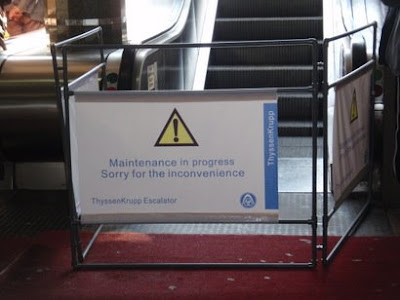
Nature was in full bloom, and even mankind in Croatia had undergone a remarkable change. After seeing "Maintenance in progress. Sorry for the inconvenience", I think Croatia is indeed getting ready for EU entry.
The fact that the message it in English only, shows that warnings and excuses like these are alien to the Croatian spirit, but let's not be too critical for a change.
Then follows the tradition chaos at Črnomerec, a bus station that looks like it could be anywhere from Vladivostok to Skopje to Warsaw.
After you get off from the bus (in Gornje Vrapče, at the foot of Medvednica) you quickly realize time passes slower here. Sometimes you get the feeling you are witnessing a scene that fits a horror movie.

The hiking trails are sometimes in good sometimes in bad condition, but what's really tricky are the terrible road marks. Judging by the condoms on the ground, open spaces in Medvednica are a favorite spot for youngsters.

The many brooks that run along the slopes Medvednica down to Zagreb are an excuse why Zagreb still doesn't have subway. Currents beneath the surface would render building an underground impossible. The real reason, of course, lies in the lack of money and skills, but blaming a brook is easier.
After a nice walk the outskirts of Zagreb reveals themselves, as do the large estates of Zagreb's upper class. Knowing that Croatia's coast is only a good hour driving from Zagreb, one marvels at the diversity of this small country.
Unfortunately, no one is paying for these nice words. I just feel like being on the Mediterranean coast now, sipping wine under a palm tree and eating fried squid rings.


Wolfram Alpha reduces Croatia

It is clear now: the Brits have started a war against Croatia. After negative reports and articles, the Brit Stephen Wolfram (the guy behind search engine Wolfram Alpha) tries to rewrite Croatian history and enlarge Slovenia at the expense of Croatia. Take a look at Wolfram's map of Croatia.
You will notice that Slovenia gained the northern part of Istria and in that way secured its access to international waters. And who was president of Croatia in 1994? Franjo, sorry, dr. Franjo Tuđman, you would say. But no! It's Milan Martić, according to Wolfram. A četnik! (says Večernji list).
To stop Wolfram from further tarnishing Croatia, I invite you to report any (deliberate? malicious?) mistakes and any information that might reveal this Great British-Slovenian-Serbian-German conspiracy. German? Yes. Look at the far East of Croatia and find out that some Croatian territory (around Ilok) was rendered to Serbia. The village of Nijemci was always safely in Croatian territory, but it now dangerously close to the Serbian border. Nijemci is Croatian for "Germans". And guess what? Stephen Wolfram's parents were German Jews. I expect the village will soon be spelled "Nemci".

No more smoking

From tomorrow onwards, smoking in public places in Croatia is forbidden. Bars and pubs are considered public places, which means no more cigarettes while sipping your morning coffee. Personally, I think coffee shops are private businesses and therefore the owner should decide does he allow guests to smoke or not. However, being a non-smoker, I do hate the stench of smoky clothes after a beer with friends, so I am willing to compromise my principles. Non-smoking bars don't exist here, so basically you had the choice to get smoked or drink at home.
Smokers will face heavy fines (1000 kuna). If the waiter in the restaurant or cafe didn't urge the smoker to put out the cigarette, he will have to pay up to 15.000 kuna, and the owner of the place up to 150.000 kuna. That's more than 20.000 euro. I don't see that happening. Both smoking and breaking the rules are a way of life here, but let's be optimistic for a change. Only when winter starts again and we'll be forced to drink inside I'll have the opportunity to smell if the law is effective.

Everybody loves Croatia (less)

On the day that media speculate about the political future of Tourism minister Bajs, there is even more bad news for the man already under fire. First, the BBC has a lengthy article on its website about Croatia with the title "Croatia cursed by crime and corruption". It reads:
"Britain's Foreign Office is warning visitors to Croatia this summer to beware of a threat from organised crime, following a number of assassinations and attacks on prominent figures, reports Matt Prodger. "We heard a very loud and low noise, something like voooom!" On the evening of 23 October 2008, Irena Scuric was eating.." You can read the rest here.
I heard the "voooom" too, as I was waiting for the tram on Zagreb's main square. First I thought the cannon on the Lotrščak Tower was fired. Every day, precisely at noon, the old cannon fires, something that can be heard at great distance. As it was around 17.30 I guessed they fired it for a special reason.
When I came home, I found out that the "voooom" was a blast that blew up Ivo Pukanić, a prominent journalist, and his car.
Once more the BBC. "Car bombs are one thing, corruption another, and you do not have to go far to find it. The newspapers are full of stories of dodgy dealings and prominent figures with unexplained wealth."
All of this is true, partly also because Croatian newspapers largely ignore things that happen elsewhere in the world. But is it necessary to warn visitors for "a threat from organised crime"? I think that is a bit too much. There is the unsolved murder case in Dubrovnik, but generally Croatia is a very safe country. Just stay away from politics, war criminals, business tycoons, and you'll be pretty safe.
Anyway, the Foreign Office's warning comes at a delicate moment. Croatia is hit hard by the economic crisis and fears for a bad tourist season. Additional bad news is that less Europeans plan to spend their holidays in Croatia. According to the EU's Survey on the attitudes of Europeans towards tourism 2,3 percent all non-domestic holidays would be spend in Croatia, significantly less than the 3,4 percent of 2008.
This fact is lost on Croatian media. Novi list, for example writes under the title "Europeans love Croatia" that "one out of four Slovenes, 8 percent of the Czechs, 3 percent of the Poles and 13 percent of the Romanians and Slovaks" plan to go to Croatia in 2009.
Wonderful! But still bad news if you know that in 2008 an amazing 41 percent of Slovenian holidaymakers went to Croatia, 20 percent of the Slovaks, 18 percent of the Czechs, and so on.
So, when you do come to Croatia, you might have it all for yourself. Not so bad.